1662 articles
Scientists using artificial intelligence tools publish 3× more papers and earn 5× more citations annually, but new research reveals a significant trade-off in how discovery happens.
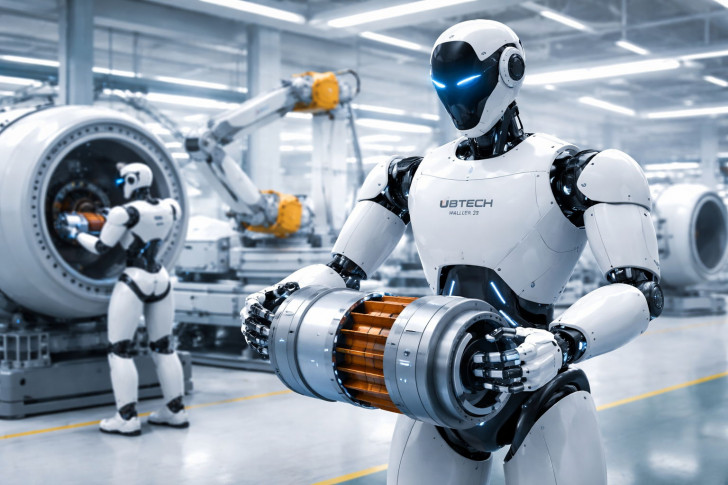
Humanoid robots are stepping into real factory jobs as UBTECH's Walker S2 takes over repetitive tasks at Sany Heavy Industry's wind turbine plant, handling 15-kilogram loads and working alongside human supervisors.
University of Hong Kong and Adobe Research have unveiled Self-E, a breakthrough self-evaluation training method that delivers high-quality text-to-image generation whether you need 1 step or 100.
Groq's Jonathan Ross flips the AI unemployment narrative on its head, claiming efficiency gains will actually shrink the workforce as cheaper living costs let people work less—potentially triggering labor shortages instead of mass layoffs.
Anthropic has revealed a broad expansion of its research and engineering hiring, pointing to work across audio, biology, cybersecurity, scientific discovery, and computer vision. The new roles highlight the company's growing ambitions beyond text-based AI.
OpenAI's CFO revealed the company's revenue has grown in lockstep with computing power—jumping from $2B to over $20B ARR as compute scaled nearly 10x. The data shows ChatGPT has transformed from experimental tool into critical infrastructure that powers decision-making across enterprises.
OpenAI reveals that AI revenue growth scales directly with compute capacity, showing how a tenfold increase in power infrastructure from 200 megawatts to 2 gigawatts drove annual recurring revenue from $2 billion to over $20 billion.
Researchers have introduced KnowVal, a new autonomous driving system that integrates real-world knowledge and value-based reasoning to improve safety and decision-making in complex driving scenarios.
Okara rolls out GLM 4.7 Flash, a 30-billion parameter AI model with a massive 200,000-token context window, targeting coding tasks, creative writing, and long-form content processing.
xAI is developing "human emulators," AI systems designed to perform on-screen tasks the same way a human user would, without requiring changes to existing software.
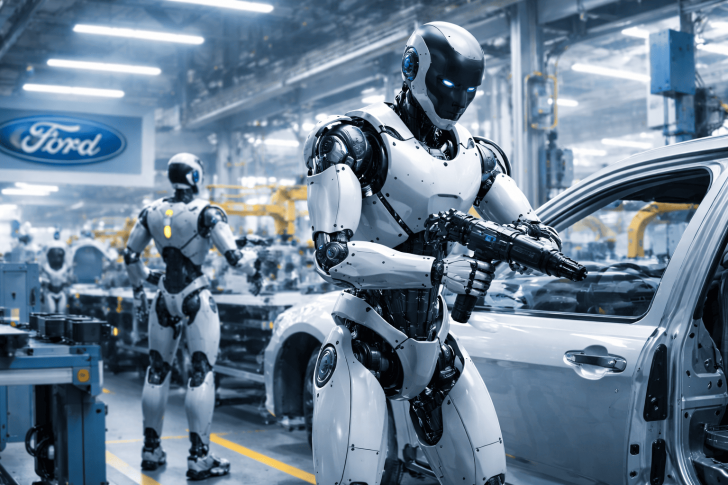
Ford's Cologne plant successfully tested a humanoid robot for six weeks, achieving 97% reliability in autonomous manufacturing tasks—signaling a potential shift in how car factories handle flexible automation.
Researchers have introduced AP2O-Coder, a new training framework that reduces compilation and runtime errors in AI-generated code by analyzing and correcting specific failure types through targeted learning.
Researchers from China's leading universities have cracked open the "black box" of AI by mapping how large language models actually function through six distinct lifecycle stages, revealing both breakthroughs and critical gaps in our understanding.
Moonshot AI's Kimi agent just proved it can build, test, and host websites completely on its own. Using only natural language commands, the AI handled everything from coding to deployment without human intervention.
Meta AI saw explosive growth in late 2025, with downloads jumping 157% and monthly active users surging 274% from Q3 to Q4. Website traffic nearly doubled as the platform gained traction across mobile and web.
ModelScope just dropped STEP3-VL-10B, a lean multimodal model that's punching way above its weight class. With under 10 billion parameters, it's matching or beating models 10-20 times its size across vision and reasoning benchmarks.
A new research method replaces autoregressive speculative decoding with discrete diffusion to accelerate large language model inference. Tests show substantial speedups while preserving identical output quality.
China just dropped AgentScope, a Python-based open-source framework that makes it easier to build AI applications where multiple agents work together, complete with memory, tools, and reasoning built right in.
Microsoft released VibeVoice, an open-source real-time speech generation system that delivers conversational audio with just 300 milliseconds of latency, supports up to 90 minutes of continuous output, and handles four different speakers in a single session.
A new academic study reveals how AI agents can be secretly tricked into burning through massive computing resources while still giving you the right answers. It exposes a critical blind spot in how these systems interact with external tools.
We use cookies to improve your experience on our site and to show you relevant advertising. To find our more, read our privacy policy and cookie policy


 Alex Dudov

 Victoria Bazir
 Eseandre Mordi

 Usman Salis

 Saad Ullah


 Sergey Diakov




 Peter Smith