1662 articles
Ollama has introduced Pi, a minimal coding agent designed for customizable AI workflows. The tool expands development capabilities within the Ollama ecosystem.
Trace2Skill is a new framework that improves AI performance by converting execution traces into reusable skills. The method avoids model parameter updates entirely while enhancing task outcomes across a range of agent-based systems.
China's first fully automated humanoid robot production line in Foshan can produce over 10,000 units annually - with robots building robots around the clock.
Kuaishou's Kling Team has introduced HyDRA, a hybrid memory system that keeps AI-generated subjects consistent even when they leave the frame entirely.
Researchers introduced OPUS, a dynamic data selection method for LLM pre-training that delivers up to 8x computation reduction while boosting benchmark accuracy by 2.2% on average.
NVIDIA has released Privasis, a synthetic dataset designed to train AI models for text sanitization. The dataset includes over 54 million annotated privacy attributes spanning medical, financial, and legal documents.
Microsoft has open-sourced VibeVoice, a voice AI system capable of processing long-form audio and real-time speech tasks. The model supports structured transcription, multilingual capabilities, and low-latency voice generation.
Huawei and Shanghai Jiao Tong University introduced HyperOffload, a compiler-assisted framework that reduces LLM peak device memory usage by up to 26%. The solution rethinks how data moves across AI hardware - maintaining performance while solving one of the field's core infrastructure challenges.
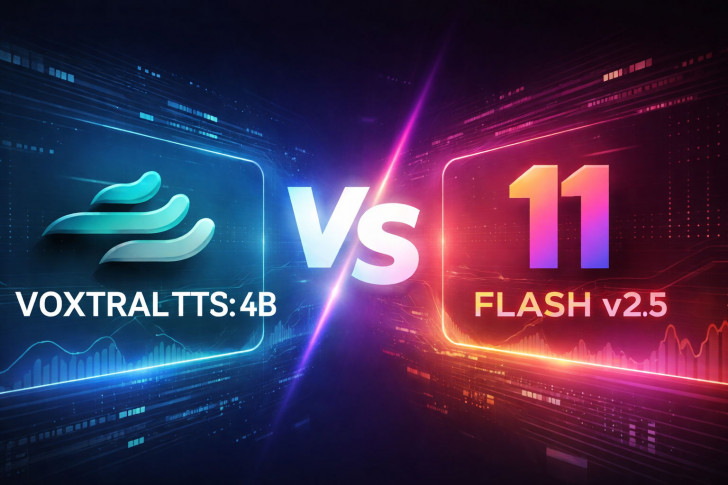
Mistral AI released Voxtral TTS, a multilingual speech model generating expressive audio from minimal input. Early evaluations show it outperforming ElevenLabs Flash v2.5 with a 62.8% win rate in human preference tests.
Humanoid robots are being piloted in hospitals to assist with routine operations. Early deployments focus on reducing workload through automation of non-clinical tasks.
NVIDIA and academic researchers introduced EGGROLL, a new method for training AI models without gradient-based backpropagation. The approach uses low-rank evolution strategies to improve efficiency and scalability for large models.
A new token-dropping technique accelerates large vision-language models at inference time - no retraining, no architectural changes, and minimal performance loss.
Elon Musk outlined three key pillars for AI safety, focusing on truth, curiosity, and beauty as guiding values for future systems.
OpenAI has released a Codex Use Cases gallery, giving developers access to ready-made workflows and prompts directly inside its coding environment.
GPT-5.4 achieved 95% accuracy on the 2026 USA Math Olympiad benchmark, marking a sharp improvement from prior-year results.
A new JEPA-based AI framework simplifies world model training, achieving planning speeds up to 48 times faster with minimal compute resources.
New evaluations show GLM-5.1 closing in on Claude Opus 4.6 in coding performance, highlighting a shrinking gap between open and proprietary AI models.
A new benchmark, MME-Emotion, evaluates emotional intelligence in AI using thousands of video samples. Results show current models still struggle with emotion recognition and reasoning.
Meta released SAM 3.1, improving video processing efficiency with object multiplexing. The update enables higher performance across workloads on a single H100 without sacrificing accuracy.
A new study shows AI agents can autonomously create advanced jailbreak attacks, outperforming over 30 human-designed methods - and hitting up to 100% success rates against specific models.
We use cookies to improve your experience on our site and to show you relevant advertising. To find our more, read our privacy policy and cookie policy


 Usman Salis
 Victoria Bazir

 Saad Ullah

 Eseandre Mordi


 Peter Smith