Artem Voloskovets

The analyst report, dated September 17, puts Alphabet shares at $347.33, giving the new target 39.64% implied upside. Tigress attributes the higher valuation primarily to Alphabet's AI infrastructure and its ability to deploy the same technology across Search, Google Cloud and YouTube.
Alphabet’s full-stack AI leadership accelerates growth across Search, Cloud, and YouTube. — Tigress Financial Partners
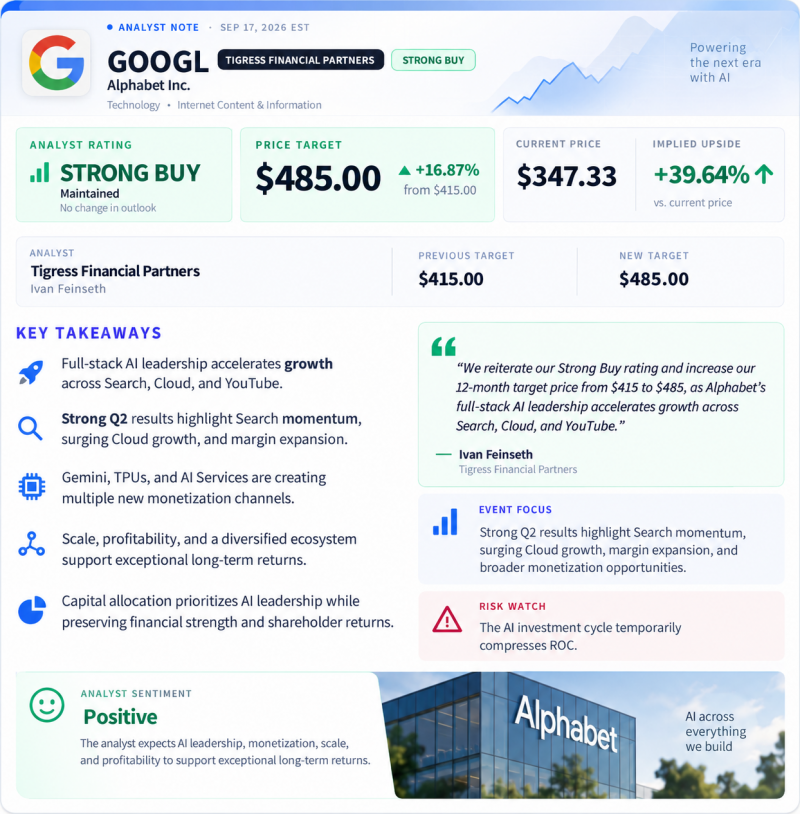
What Changed From the Previous $415 Target
Tigress did not change its rating. Instead, it increased the value assigned to Alphabet's AI-driven growth and monetization.
| Metric | Previous | New |
| Price target | $415 | $485 |
| Target increase | — | 16.87% |
| Rating | Strong Buy | Strong Buy |
| Share price in report | — | $347.33 |
| Implied upside | — | 39.64% |
The previous thesis centered on Alphabet's ability to defend and expand its core businesses with AI. The updated analyst note emphasizes that the investment is already creating additional monetization channels through Gemini, TPUs and AI services, while supporting growth in Search, Cloud and YouTube.
Alphabet's Full-Stack AI Architecture
Alphabet differs from companies that primarily build an application on top of third-party AI infrastructure. Google controls much of the stack itself.
At the compute level, Google develops its own Tensor Processing Units (TPUs) for machine-learning training and inference. These accelerators run inside Google's data-center infrastructure and support both internal workloads and Google Cloud customers.
Above the hardware layer sits the Gemini model family. Google can expose these models through developer APIs and enterprise services while simultaneously integrating them into its own products.
The architecture effectively looks like this:
TPUs → Google data centers → Gemini → APIs/Google Cloud → Search, YouTube, Workspace and other applications
This gives Alphabet several ways to monetize the same underlying infrastructure. Compute can be sold through Google Cloud, Gemini through APIs and enterprise products, while AI features can increase usage and advertising opportunities inside Search and YouTube.
Google Cloud Is Becoming the Infrastructure Layer
Cloud is particularly important to the Tigress thesis because it converts Google's internal AI technology into an external platform. In Q2 2026, Google Cloud revenue reached $24.8 billion, compared with $13.6 billion in Q2 2025. That represents roughly 82% year-over-year growth, versus about 32% a year earlier.
Cloud backlog also increased sharply, from approximately $106 billion to $514 billion.
| Google Cloud | Q2 2025 | Q2 2026 | Change |
| Revenue | $13.6B | $24.8B | +82% |
| Backlog | $106B | $514B | ~4.8× |
The Google artificial intelligence business is broader than the provision of access to Gemini for software engineers and large companies. The customers use models, infrastructure for artificial intelligence, storage, databases and computing resources within the same Cloud environment. In this environment, the users manage those components together. There are many services available for the organizations to integrate - but Google provides those various tools in one location to assist the users. With this structure, the business supports the complex needs of the entities.
That increases the amount of revenue Alphabet can generate from an AI workload even when the final application has no direct Google branding.
AI Is Also Expanding Search
Search remains Alphabet's most important test because generative responses require substantially more compute than conventional search results.
Tigress argues that AI is expanding Search and strengthening advertising. Alphabet's numbers provide some support for that view: Search revenue growth accelerated from roughly 12% in Q2 2025 to 17% in Q2 2026.
The engineering challenge is cost. Traditional search retrieves and ranks indexed information. Generative search adds model inference to that pipeline, increasing accelerator, memory and power requirements per query.
Google's ownership of both TPUs and the Gemini software stack gives it more opportunities to optimize this path. Improvements can be made at the model, compiler, accelerator, serving and data-center levels instead of relying exclusively on external GPU hardware.
At Google's scale, even relatively small reductions in inference cost can become significant when applied across billions of queries.
Gemini and TPUs Add New Revenue Channels
Tigress specifically identifies Gemini, TPUs and AI Services as sources of additional monetization.
Gemini can generate revenue through enterprise subscriptions and API consumption. TPU capacity can support both Google's products and external Cloud workloads. AI functionality can also increase the value of existing services such as Search advertising, Workspace and YouTube.
This creates a different economic model from selling a standalone AI assistant.
Alphabet can monetize AI at several points in the stack:
- infrastructure and accelerator capacity through Google Cloud;
- Gemini models through APIs and enterprise services;
- productivity AI through Workspace;
- AI-enhanced Search through advertising;
- recommendation and advertising systems through YouTube.
The same R&D and infrastructure investments can therefore support several businesses.
The Cost: $195–205 Billion in CapEx
The strategy requires exceptional infrastructure spending. Alphabet expects approximately $195–205 billion in 2026 capital expenditures, largely associated with servers, accelerators, networking equipment and data-center capacity needed for AI workloads.
Tigress explicitly identifies this as the main near-term trade-off:
Alphabet’s AI investment cycle temporarily compresses ROC but sets the stage for accelerating Economic Profit growth.
The key metric is therefore not AI usage alone. Alphabet needs revenue generated by the new capacity to grow quickly enough to justify the capital invested in it.
Higher TPU utilization, increasing Cloud workloads and greater Gemini API consumption improve infrastructure economics. Excess capacity or slower monetization would pressure return on capital.
Why Tigress Raised the Target to $485
The move from $415 to $485 reflects a broader view of Alphabet's AI opportunity. The company is not dependent on a single Gemini product. It owns custom AI accelerators, data centers, models, APIs, a major cloud platform and several applications with billion-user-scale distribution.
Q2 results strengthen that argument: Google Cloud revenue rose 82%, Cloud backlog approached $514 billion, Search growth accelerated, and operating margin expanded despite heavy AI investment.
The technical question behind Tigress's new target is now whether Alphabet can convert that infrastructure scale into sustained returns.
The company has already built most layers required to do it: silicon, compute, models, developer APIs, enterprise distribution and consumer applications. The next phase is turning rapidly increasing AI workloads into enough revenue and operating profit to offset one of the largest infrastructure investment cycles in Alphabet's history.
 Artem Voloskovets