1662 articles
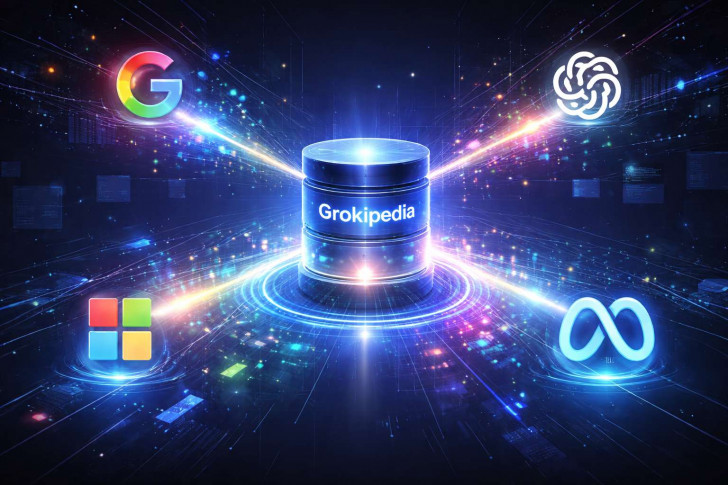
Grokipedia is becoming a go-to knowledge source for leading AI platforms. ChatGPT, Google Gemini, Perplexity, and Microsoft AI products are now actively citing it in real-world user responses.
Ant Group researchers just dropped LingBot-VLA, a vision-language-action AI model that can control multiple robot types through a single system. The model crushes existing approaches in both performance and training speed across real-world robotic tasks.
Fennec, a newly unveiled large language model, is making waves with its massive 1 million token context window and pricing that undercuts leading systems by 50%, while claiming superior benchmark performance.
Five next-generation AI systems—including Sonnet 5, GPT-5.3, and Gemini 3—are heading toward release within weeks of each other, marking an unprecedented concentration of major AI launches.
Former OpenAI research lead Jerry Tworek broke down why current AI models still fall short of artificial general intelligence, pointing to resilience and self-correction as the missing pieces.
A new world-model system called DualWorld enables humanoid robots to combine advance planning with real-time action. The approach allows robots like Fourier GR-3 to perform complex household tasks more efficiently.
Elon Musk revealed why he shifted from AI critic to builder, driven by worries about ethics and bias. His stance positions xAI's Grok as a tool to directly shape artificial intelligence's evolution.
AI-supported breast cancer screening identifies more clinically relevant cancers without increasing false-positive rates, improving early detection while maintaining human oversight.
Tesla has laid out a multi-generation plan to push its AI compute from small early-stage deployments all the way past 100 gigawatts per year. Dojo and its custom AI chips sit at the center of that long-term vision.
Developers are splitting their AI workflows in 2 — using Claude Code for planning and ChatGPT Codex for execution. Here's why that combo is becoming the new standard.
New wage-based compensation models for AI systems are showing significant efficiency improvements, with early testing revealing productivity gains of 20-50% as agents optimize their resource usage to maximize earnings.
Nvidia has ended discussions about a major investment in OpenAI after negotiations broke down, with the chip giant clarifying that the widely reported $100 billion figure was never a done deal.
The Open Gaming Collective brings together Linux gaming projects to end duplicate development work and build shared infrastructure. The initiative targets better performance across desktops, handhelds, and emerging platforms through centralized collaboration.
Elon Musk revealed a potential Starlink-connected mobile device concept built specifically for AI workloads. The proposed phone would prioritize on-device neural network execution and energy efficiency over traditional smartphone features.
A breakdown of DevOps, MLOps, and LLMOps explains why traditional software workflows struggle with modern AI systems. The comparison highlights structural differences in tooling, monitoring, and cost models that separate AI operations from conventional software deployment.
Mercury's latest data reveals Anthropic has overtaken OpenAI as the top choice for AI spending among newly launched startups, claiming over 50% market share by Q4 2025 as early-stage companies rapidly embrace Claude's newer capabilities.
New financial analysis reveals GPT-5 achieved 45% gross margins on $6.1 billion in revenue but recorded a $1.9 billion net loss after operating costs. The numbers expose the massive spending required to scale cutting-edge AI models.
Grok 4 moves back into first place in an ongoing AI trading competition, delivering 11% returns and outpacing both Claude Sonnet 4.5 and the S&P 500's 2.8% gain since late November.
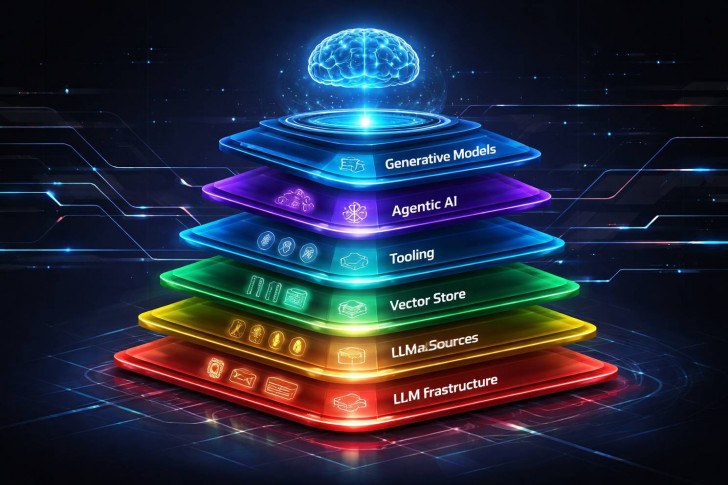
A viral framework visualizes AI as a 7-layer stack showing how Agentic AI coordinates lower layers instead of replacing them, redefining how the technology works.
Meta Platforms is emerging as a top AI beneficiary thanks to its massive global reach across Facebook, Instagram, and WhatsApp. With over 3.5 billion people using its apps daily, the company's scale is becoming its strongest weapon for rolling out AI products.
We use cookies to improve your experience on our site and to show you relevant advertising. To find our more, read our privacy policy and cookie policy


 Saad Ullah
 Victoria Bazir

 Eseandre Mordi

 Peter Smith


 Usman Salis