1846 articles
Former OpenAI research lead Jerry Tworek broke down why current AI models still fall short of artificial general intelligence, pointing to resilience and self-correction as the missing pieces.
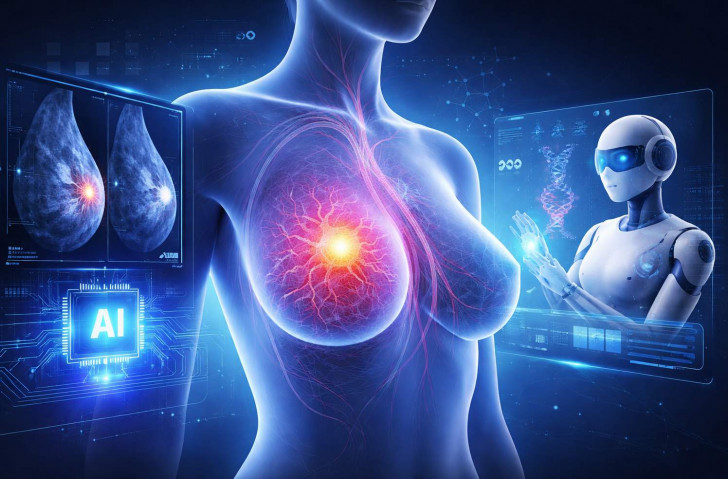
AI-supported breast cancer screening identifies more clinically relevant cancers without increasing false-positive rates, improving early detection while maintaining human oversight.
Anthropic has opened up its Claude plugin system so that non-technical business teams can build custom AI workflows — no coding or engineering support needed.
vLLM-Omni v0.14.0 is here — the first production-ready multimodal inference platform built to handle text, image, audio, and video workloads under one roof.
SecureShell has been featured in LangChain's Community Spotlight as a zero-trust security layer that validates and blocks risky shell commands before LLM agents can execute them.
Major AI hyperscalers are spending more than anyone expected — and the numbers for 2026 are only getting bigger, with capex projections now sitting at $561 billion.
OpenMed has kicked off an 8-day open-source dataset release series, dropping 225K medical reasoning samples to help train next-gen healthcare AI models.
OpenAI's funding needs are about to get massive — projections now point to up to $1.4 trillion in total spending over the next eight years, all driven by cloud deals, chip costs, and infrastructure buildout.
Tesla has laid out a multi-generation plan to push its AI compute from small early-stage deployments all the way past 100 gigawatts per year. Dojo and its custom AI chips sit at the center of that long-term vision.
Developers are splitting their AI workflows in 2 — using Claude Code for planning and ChatGPT Codex for execution. Here's why that combo is becoming the new standard.
New wage-based compensation models for AI systems are showing significant efficiency improvements, with early testing revealing productivity gains of 20-50% as agents optimize their resource usage to maximize earnings.
A new research paper from Isotopes AI presents a multi-agent system design that enables fully autonomous organizations through structured AI coordination.
Grok 4 has posted the strongest early performance among AI-driven portfolios, opening with an 11.2% gain that clearly outpaces competing models in initial tracking data.
China demonstrates significantly higher public enthusiasm for AI than global peers while capturing a growing share of open-source developer activity, signaling a fundamental shift in the AI development landscape away from traditional Western tech hubs.
The Open Gaming Collective brings together Linux gaming projects to end duplicate development work and build shared infrastructure. The initiative targets better performance across desktops, handhelds, and emerging platforms through centralized collaboration.
Elon Musk revealed a potential Starlink-connected mobile device concept built specifically for AI workloads. The proposed phone would prioritize on-device neural network execution and energy efficiency over traditional smartphone features.
A breakdown of DevOps, MLOps, and LLMOps explains why traditional software workflows struggle with modern AI systems. The comparison highlights structural differences in tooling, monitoring, and cost models that separate AI operations from conventional software deployment.
Semrush's latest experiment reveals ChatGPT's product recommendations mirror Google Shopping rankings, with three-quarters of top picks coming from Google's top three results. The data shows Google Shopping visibility now directly drives AI-powered product discovery.
Semrush's latest research reveals Google's AI Overviews appear in 16% of U.S. desktop searches, down from a 25% peak in mid-2025. The shift signals AI-generated answers are becoming a permanent search fixture that's changing how brands compete for visibility.
OpenAI is pulling the plug on six older ChatGPT models, including GPT-4o and GPT-4.1, starting February 13, 2026. The retirement affects only ChatGPT users, while API access remains unchanged for now.
We use cookies to improve your experience on our site and to show you relevant advertising. To find our more, read our privacy policy and cookie policy


 Saad Ullah
 Eseandre Mordi
 Artem Voloskovets

 Usman Salis

 Marina Lyubimova
 Peter Smith