1846 articles
Perplexity's Advanced Deep Research system topped a new evaluation measuring AI accuracy across 100 real-world tasks, beating competitors from Google, OpenAI, and Anthropic in the cross-domain benchmark.
Alphabet reported record annual revenue exceeding $400 billion driven by explosive AI adoption across its Gemini ecosystem, cloud services, and search products, with enterprise usage expanding to over 120,000 organizations.
xAI's Grok Imagine debuts at the top of Video Arena rankings with a 1351 score, outpacing competitors while also delivering the fastest generation speeds among all tested video models.
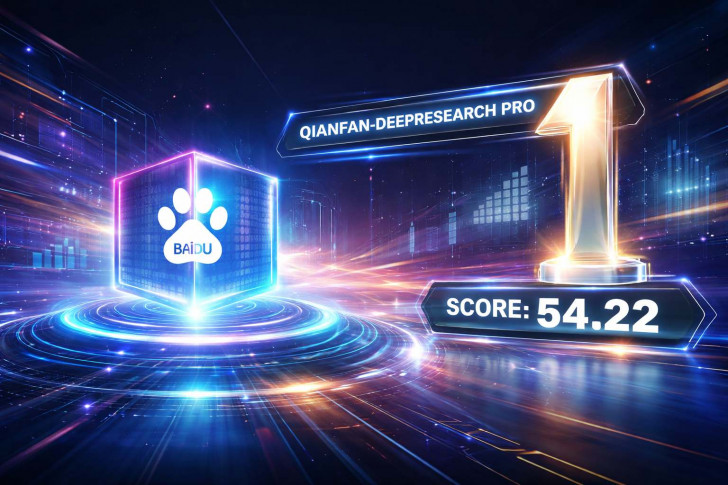
Baidu's Qianfan-DeepResearch Pro has secured first place on the DeepResearch Bench leaderboard, outperforming competing AI research agents in end-to-end autonomous research capabilities.
Grok's user base climbed 29% month-over-month while downloads spiked 43% in January 2026, marking the platform's fourth straight month of expansion.
ModelScope has released ACE-Step v1.5, an open-source music foundation model designed to run locally on consumer GPUs. Benchmark results show strong performance and significantly faster generation speeds compared with many existing models.
New benchmark reveals that top multimodal AI systems struggle with genuine visual comprehension, with even advanced models failing to reach 50% accuracy on challenging image-based questions that test real-world understanding.
OpenBMB's new MiniCPM-o 4.5 model packs full-duplex multimodal capabilities into just 9 billion parameters, achieving state-of-the-art benchmark scores through architectural innovation rather than brute-force scaling.
Google Research is teaming up with Included Health to test how medical AI actually performs in real-world virtual healthcare settings. This nationwide randomized study will evaluate both what these AI systems can do and where they fall short.
Generative AI just crushed every other online industry in 2025, nearly doubling its traffic from 4.4 billion to 8 billion monthly visits year over year, according to fresh Similarweb data.
Grokipedia has blown past 500,000 Grok-approved edits, showing just how fast its real-time, AI-verified knowledge system is scaling up.
Kimi K2.5 has taken the lead among open-source AI models in Code Arena's agentic coding rankings, scoring 1447 points and placing fifth overall against both open and proprietary systems.
xAI just dropped a Batch API for Grok that lets enterprises process massive AI workloads asynchronously—think higher throughput, lower bills, and way more control over large-scale operations.
Sourceful's Riverflow 2.0 just claimed the top spot on Artificial Analysis leaderboards for text-to-image and image editing, beating out major players from OpenAI, Google, and Black Forest Labs.
AI can speed up building and coordination, but it can't generate strong ideas on its own. Without clear direction, multi-agent systems end up creating volume instead of quality.
Grokipedia is becoming a go-to knowledge source for leading AI platforms. ChatGPT, Google Gemini, Perplexity, and Microsoft AI products are now actively citing it in real-world user responses.
Fennec, a newly unveiled large language model, is making waves with its massive 1 million token context window and pricing that undercuts leading systems by 50%, while claiming superior benchmark performance.
xAI just rolled out Grok Imagine 1.0, bringing 10-second video generation and upgraded audio features to its platform. The new capabilities are live now across Grok apps and APIs.
The Trade Desk rolled out OpenAds, a programmatic auction platform built for transparency and supply chain efficiency. Major publishers are already on board, and the company held firm on its Q4 2025 financial targets.
Five next-generation AI systems—including Sonnet 5, GPT-5.3, and Gemini 3—are heading toward release within weeks of each other, marking an unprecedented concentration of major AI launches.
We use cookies to improve your experience on our site and to show you relevant advertising. To find our more, read our privacy policy and cookie policy


 Marina Lyubimova
 Usman Salis
 Saad Ullah
 Victoria Bazir
 Eseandre Mordi


 Peter Smith