1846 articles
ModelScope releases Step-3.5 Flash large language model as open source with its SteptronOSS training framework, showing strong performance across coding, reasoning, and agent benchmarks.
Microsoft's rumored Windows 12 could introduce deeper AI integration through Copilot and a redesigned interface. Reports suggest some advanced AI features may be offered through a subscription model.
Anthropic's Claude Opus 4.6 reportedly solved a long-standing mathematical conjecture by legendary computer scientist Donald Knuth. The breakthrough highlights growing interest in advanced AI reasoning systems in scientific research.
New marketing data from 50 websites shows AI platforms like ChatGPT and Gemini generate higher customer lifetime value than traditional search engines, even as Google retains its lead in raw traffic volume.
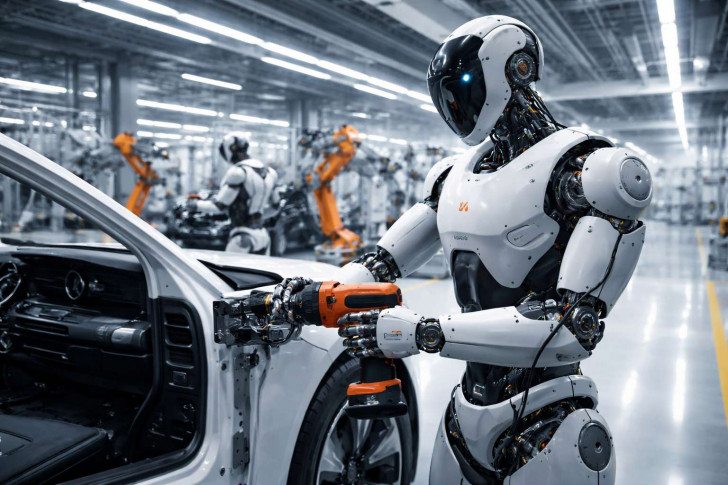
Noble Machines has unveiled an industrial humanoid robot already working inside a Fortune Global 500 facility, built by a team from SpaceX, NASA, and Apple to handle hazardous and physically intensive tasks.
Meta researchers introduced a structured reasoning method that forces AI systems to trace code step by step, significantly improving accuracy when verifying software updates without executing the code.
Anthropic rolled out a free interactive prompt engineering course with hands-on Claude notebooks that's already racked up more than 31,900 stars on GitHub, showing massive developer interest.
Cognition's early SWE-1.6 language model preview shows improved reasoning performance on the SWE-Bench Pro coding benchmark, achieving a 51.7% score while maintaining fast inference speed.
Google DeepMind has launched Gemini 3.1 Flash-Lite, claiming faster throughput and lower pricing than Gemini 2.5 Flash. The model adds adjustable reasoning levels designed to handle complex tasks more cost-efficiently.
MIT researchers discovered that large language models often degrade in quality when they process their own previous responses, a phenomenon called "context pollution" that could reshape how AI systems are built and deployed.
xAI has launched Grok 4.20 Beta 2 with improved instruction following, reduced capability hallucinations, better LaTeX support, and stronger multimodal performance - continuing Grok's fast-paced development cycle.
New web traffic data shows Claude.ai accelerating sharply in the second half of February 2026, closing in on competitors Grok and DeepSeek. The trend highlights shifting user engagement among leading generative AI platforms.
Screenshots from public repository edits suggest GPT-5.4 could introduce a 2 million token context window, full-resolution vision, and faster response tiers. Community prediction markets already assign high odds to an imminent release.
Xiaomi's humanoid robots completed a continuous 3-hour assembly trial in its EV plant, reaching 90.2% installation accuracy and signaling the company's push toward full factory automation within five years.
Anthropic's Claude AI services experienced multiple partial outages this month, raising questions about reliability as the company scales rapidly. While uptime metrics remain above 98%, clustered disruptions suggest potential infrastructure strain.
OpenAI's latest GPT-5.3 Codex model has claimed the top spot on the WeirdML benchmark with a 79.3% score, edging out Claude Opus 4.6 while keeping costs surprisingly low at just $2.35 per run.
Alibaba's Qwen 3.5 Small Model Series arrives with benchmark results that punch well above its weight class. The 9B variant scored 90.0 in math and reached the mid-80s to low-90s across reasoning tests, making a strong case for compact, efficient AI deployment.
A coalition of 56 researchers just released VBVR, the world's largest video reasoning benchmark. Top AI systems hit only 54% accuracy - while humans cleared 97%.
A novel automated translation framework using test-time compute scaling has demonstrated markedly higher quality output, with LLM judges preferring its translations four times more often than standard approaches.
Similarweb data shows AI tools are becoming the dominant starting point for consumer discovery, while search engines regain relevance in comparison and purchase stages. The shift marks changing patterns in online decision journeys.
We use cookies to improve your experience on our site and to show you relevant advertising. To find our more, read our privacy policy and cookie policy


 Peter Smith

 Marina Lyubimova

 Saad Ullah

 Eseandre Mordi

 Usman Salis

 Victoria Bazir