63 articles
A new NBER paper reports generative AI significantly reduces the productivity gap between workers with high and low education. An experiment involving 1,174 adults shows AI closes roughly three quarters of the initial performance difference in an incentivized task.
A new scenario maps how fast AI agents are gaining autonomy, with a capability chart showing models scaling from minutes-long tasks in early 2024 to multi-week autonomous work by late 2027 - and what that means for jobs and economic structure.
JPMorgan Asset Management highlights that advanced AI agents now handle much longer tasks with improved reliability, but many models still have high rates of incorrect answers. The research raises trust concerns as AI usage grows across industries.
A new research paper introduces a structured world model for AI agents. The concept focuses on prediction and planning rather than scaling model size.
Claude Code's latest update introduces multi-agent collaboration, allowing several AI assistants to work simultaneously on shared coding tasks with real-time coordination.
Anthropic's latest AI agents can handle complex professional work like legal analysis and customer support, raising serious questions about the future of white-collar jobs.
A 35-year veteran developer shared his experience building two minimum viable products using coordinated AI agents in approximately 30 hours, sparking discussion about agentic programming workflows.
A new research paper from Isotopes AI presents a multi-agent system design that enables fully autonomous organizations through structured AI coordination.
A new breakdown of agentic AI reveals that autonomy comes from system architecture, not just model power. The framework maps AI evolution across five distinct layers—from basic machine learning to fully governed autonomous systems.
Evernorth partners with t54 Labs to put AI-powered financial agents straight onto the XRP Ledger, automating treasury operations and compliance checks without human oversight.
A new academic study reveals how AI agents can be secretly tricked into burning through massive computing resources while still giving you the right answers. It exposes a critical blind spot in how these systems interact with external tools.
Google just launched MCP Toolbox for Databases, an open-source server that makes it way easier for AI agents to work with databases safely. The tool handles all the tricky stuff like authentication and connections behind the scenes.
A new framework called MAXS enables AI agents to look ahead before acting, simulating multiple future action paths and evaluating trajectory stability to avoid short-sighted decisions in complex multi-tool tasks.
McKinsey now officially treats AI agents as workforce members, currently deploying 20,000 agents alongside 40,000 human employees with plans to reach equal numbers in just 18 months.
Google has unveiled the Universal Commerce Protocol (UCP), an open standard enabling AI agents, apps, and retailers to communicate seamlessly throughout the shopping process, with support from major platforms like Shopify, Etsy, Wayfair, Target, and Walmart.
Nanobot debuts as an open-source MCP host that enables developers to build AI agents with flexible deployment options across chatbots, voice systems, and custom interfaces.
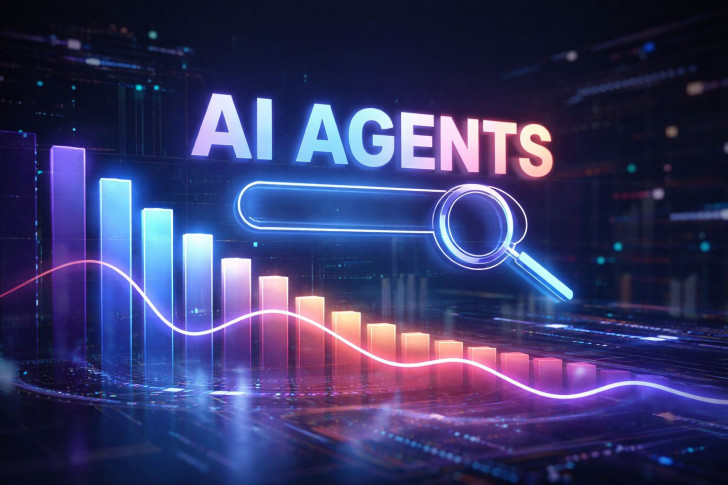
Fresh data from Similarweb reveals that worldwide searches for "AI agents" hit their peak in March 2025, then gradually cooled off throughout the rest of the year as the industry moved from initial buzz to actual implementation.
Sentient has introduced ROMA, an open-source meta-agent framework designed to manage hierarchical AI task execution through recursive planning and aggregation. The framework is built to make multi-agent coordination and workflow design easier for developers.
Chinese AI labs have introduced the Agentic Learning Ecosystem (ALE) alongside the ROME model—an open-source framework designed to improve how AI agents execute tasks, receive feedback, and learn across real-world environments.
A new "System 3" thinking layer aims to give AI agents the ability to learn from experience, build identity over time, and improve themselves—capabilities that go beyond today's perception and logic-based systems.
We use cookies to improve your experience on our site and to show you relevant advertising. To find our more, read our privacy policy and cookie policy


 Saad Ullah
 Alex Dudov
 Eseandre Mordi
 Victoria Bazir
 Marina Lyubimova
 Sergey Diakov

 Usman Salis
 Peter Smith