Marina Lyubimova
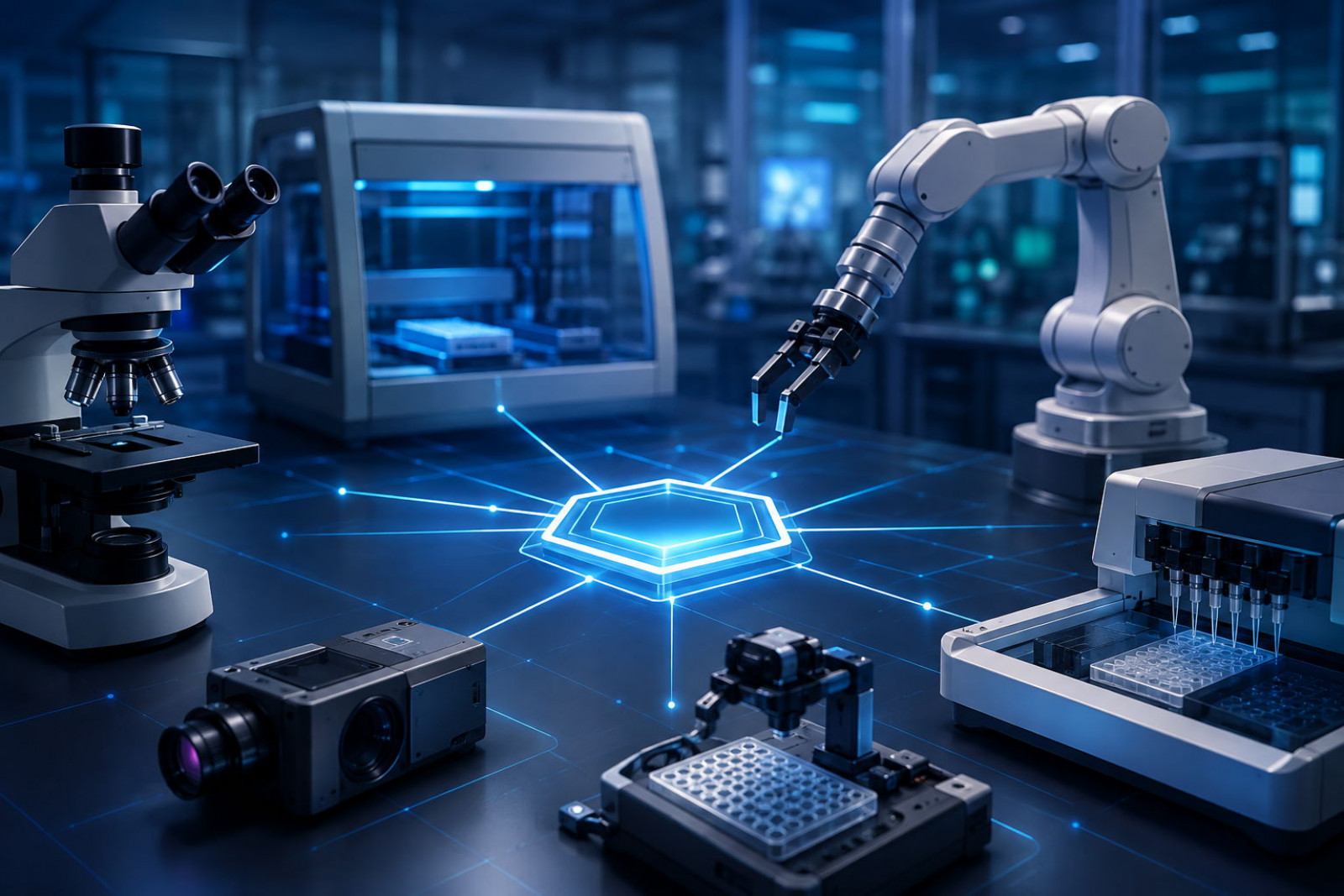
Anthropic says MHS can cut hardware integration from weeks or months to hours or minutes.
Developed initially with HHMI Janelia Research Campus, the standard is being tested in biotechnology, robotics, electronics, quantum computing and manufacturing before a planned open-source release.
Weeks of Integration Reduced to Hours
Lab and industrial equipment often uses vendor-specific programming interfaces. Connecting several instruments can require a separate integration for each device.
MHS introduces standardized drivers to replace much of this custom work.
| Conventional setup | MHS |
| Weeks or months to integrate hardware | Hours or minutes |
| Vendor-specific interfaces | Standardized drivers |
| Bespoke software between devices | Common device discovery |
| Hardware details stored in manuals | Machine-readable metadata |
| Devices controlled separately | Multi-device orchestration |
| Continuous human supervision | AI-assisted autonomous operation |
Drivers use basic commands such as “read” and “write.” An agent can retrieve a temperature, change a setting, query a sensor or control an actuator through the same basic structure.
The driver can also expose information that an API alone may not contain, including a machine's physical characteristics, measurements, adjustable parameters and safety limits.
Users can describe these properties in natural language. MHS then generates a reference file that tells the agent what the device can do and which operating limits apply.
MCP, CLI and APIs Control the Same Equipment
MHS provides three control mechanisms:
- Model Context Protocol (MCP)
- Command-line interface
- Code files/APIs
The interfaces can coordinate several devices within one workflow.
For long-running or time-sensitive operations, an agent does not need to reason before every individual hardware command. It can assemble commands into deterministic code and execute the sequence directly.
Anthropic tested this approach on a laser-alignment task. Claude adjusted a laser, used a camera to observe how the beam moved and repeated the process. It then converted the learned procedure into a script capable of performing the alignment with a single command.
The sequence was effectively:
adjust → observe → repeat → encode → automate.
AWS, QIAGEN, Tecan and Robotics Companies Are Testing MHS
At least 10 major organizations are already participating in or building around the standard. Amazon Web Services is supporting MHS through Strands Robots and will provide preview participants with a private pre-release version of the package.
Automata is adding MHS to its LINQ lab-automation platform for automated instrument error handling. Danaher and Anthropic are examining applications in smart scientific instruments and autonomous biomedical laboratories.
Doosan Robotics is testing MHS with robotic arms for automated quality assurance and coordination between multiple robots. MBF Bioscience is building an MHS driver for ScanImage, which operates laser-scanning microscopes in hundreds of neuroscience laboratories worldwide.
QIAGEN has demonstrated a proof of concept using its QIAsymphony Connect nucleic-acid purification platform. AI agents could identify equipment problems, guide operators through recovery and reduce downtime and risks to biological samples.
Tecan is adding MHS support to its Fluent liquid-handling platforms. Universal Robots plans to support the standard across its robotics platform. Hugging Face is adding MHS to its LeRobot robotics library, while Raspberry Pi is working on integrations across several products after tests with its Camera MHS Driver.
One Standard Across Labs, Factories and Robotics
Current MHS projects cover:
- laser-scanning microscopes and cameras;
- liquid-handling systems;
- nucleic-acid purification equipment;
- industrial robotic arms;
- lasers and optical equipment;
- quantum-computing systems;
- automated laboratory platforms;
- Raspberry Pi hardware.
MHS can work with any device that has a programmable interface. The specification is also model-agnostic. Claude is being used in Anthropic's tests, but other models and agent frameworks can access MHS hardware through protocols including MCP.
Physical Reasoning Remains a Constraint
Anthropic is not yet releasing MHS as open source. One reason is the gap between language-model reasoning and physical-world behavior.
During experiments with Genentech, researchers had to help Claude recognize that foaming in protein samples was a physical failure rather than a software error. The problem required a physical correction to the experiment.
The preview will therefore be used to develop physical-safety evaluations, operating practices and additional safeguards before the standard is released publicly.
MHS also cannot currently control equipment without a programmable interface. Anthropic is working with manufacturers to develop drivers for additional devices.
MHS Started With a Brain-Imaging Rig
The project originated at HHMI Janelia, where postdoctoral scientist Arco Bast was running brain-imaging experiments using lasers, motorized focusers and specialized cameras from different manufacturers.
The instruments lacked a common interface. Bast created a shared-memory dictionary allowing the devices to exchange information at memory speed. He later worked with Anthropic's Alek Kemeny to integrate AI models into the system. That work developed into MHS.
The standard now targets a broader problem: giving AI agents a common method to discover, understand and control programmable physical equipment.
MCP provides a common interface between AI agents and software tools. MHS applies a similar architecture to hardware — potentially giving the same agent access to microscopes, liquid handlers, cameras, lasers and robotic systems without building a separate integration for every machine.
 Marina Lyubimova