Atman Rathod
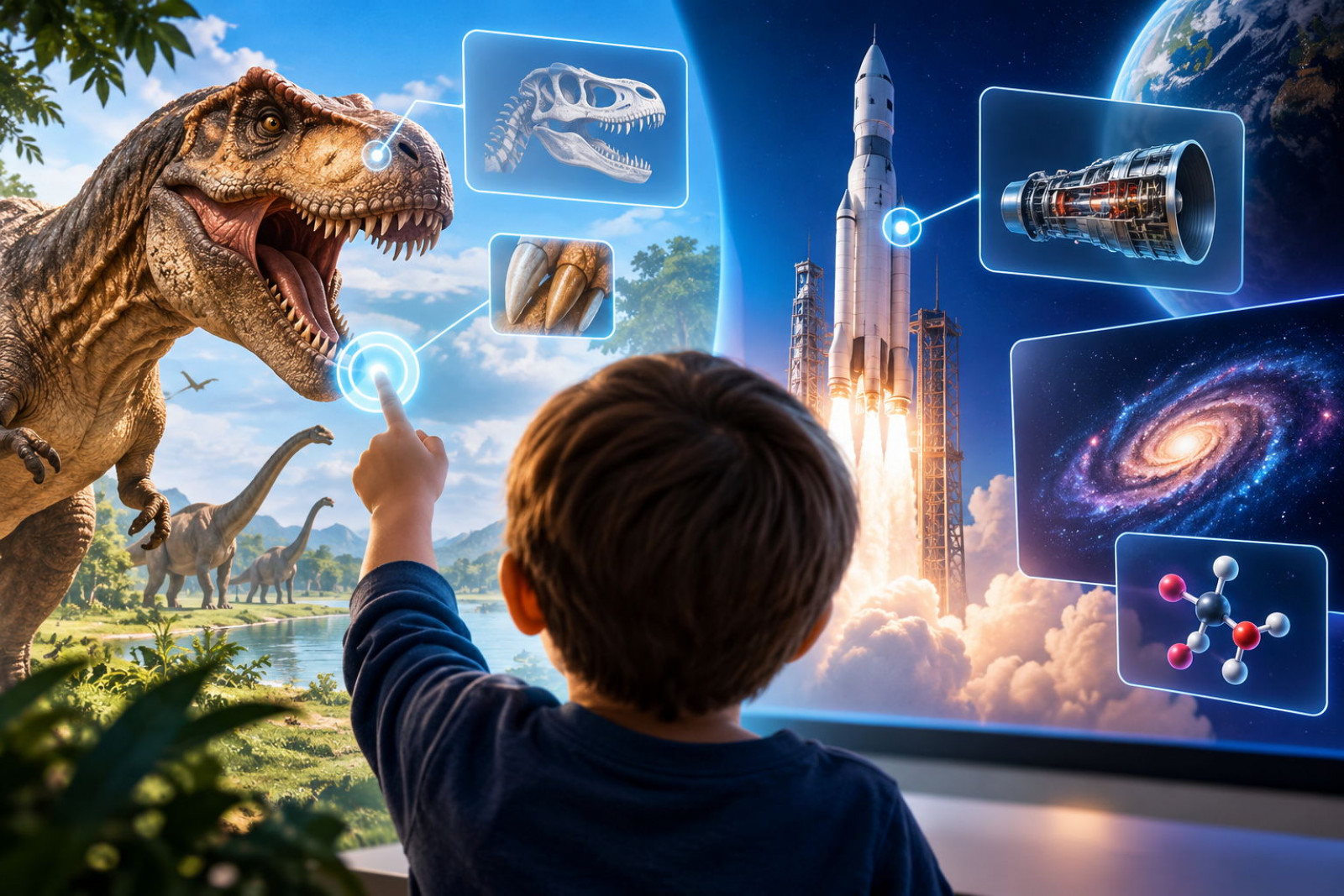
The first available topics range from dinosaurs to space and rockets. Instead of receiving a single generated explanation, users open an image containing pre-selected interactive details and drill down into individual elements.
Some exploration paths go considerably deeper than basic labels, reaching technical concepts such as molecular structures.
How Immersive View Changes Gemini
Standard Gemini learning is prompt-driven:
Question → Answer → Follow-up prompt → Answer
Immersive View is exploration-driven:
Topic → Interactive image → Selected element → Detail → Deeper detail
The key difference is that users don't need to formulate every next question themselves. Gemini provides predefined exploration points directly inside the visual interface.
| Standard Gemini | Immersive View |
| Text/prompt first | Image first |
| Linear conversation | Branching exploration |
| User chooses every question | Pre-selected details guide exploration |
| Images mostly support answers | Image becomes the interface |
| Depth requires new prompts | Information can be expanded progressively |
More Than a Static AI Image
Immersive View isn't simply Gemini generating an illustration.
A normal multimodal answer is essentially:
Prompt → Image/Text → Follow-up prompt
Immersive View adds interaction:
Topic → Image → Interactive point → Context → Deeper layer
This resembles an interactive encyclopedia or educational diagram more than a conventional chatbot.
The depth can vary by topic. For example, an exploration can start with a visible object and continue toward much smaller structural details — in some cases down to the molecular level.
Why This Matters for Developers
The important change isn't necessarily the underlying Gemini model. Gemini could already explain dinosaurs, rockets or molecules through text prompts. What's new is the UI layer around the model.
A simplified architecture looks like:
visual context → selected object → contextual query → generated explanation → next exploration level
Instead of exposing the LLM through a chat box, Google is putting it behind an interactive visual interface. That approach is particularly suitable for subjects with clear structural relationships:
- Biology: organism → organ → tissue → cell → molecule
- Space: rocket → stage → engine → component → physical process
- Engineering: machine → assembly → component → mechanism
Immersive View vs. Other Learning Formats
| Format | Navigation | Depth | Requires user questions |
| Textbook | Fixed | Fixed | No |
| Video | Linear | Fixed | No |
| Wikipedia | Links | High | Partially |
| Gemini Chat | Conversational | Very high | Yes |
| Immersive View | Visual/drill-down | Multi-level | Less |
The main advantage over video is non-linear navigation. The advantage over standard Gemini is that users can discover information without knowing the correct prompt in advance.
That is especially relevant for children: tapping a dinosaur's skeleton or a rocket engine is easier than constructing a precise question about anatomy or propulsion.
The Bigger Developer Takeaway
Immersive View is another example of AI moving beyond the standard chat interface.
For visual subjects, the interaction can instead become:
see → select → explain → drill down
The model remains the information engine, while the UI determines how users navigate that information. For educational AI, that's potentially more useful than simply putting another chatbot next to a textbook.
 Atman Rathod