25 articles
Nvidia (NVDA) has teamed up with major global telecom firms to develop AI-native 6G wireless networks - open, secure, and intelligent infrastructure built to handle tomorrow's connectivity demands well beyond what 5G can offer today.
Nvidia has ended discussions about a major investment in OpenAI after negotiations broke down, with the chip giant clarifying that the widely reported $100 billion figure was never a done deal.
Breaking down the AI semiconductor value chain reveals how hyperscaler demand creates cascading investment across chips, manufacturing infrastructure, and power systems—with NVDA at the center.
Nvidia's new 4D-RGPT model transforms how AI understands video content, delivering a 5.3% accuracy improvement in depth and motion recognition across major benchmarks.
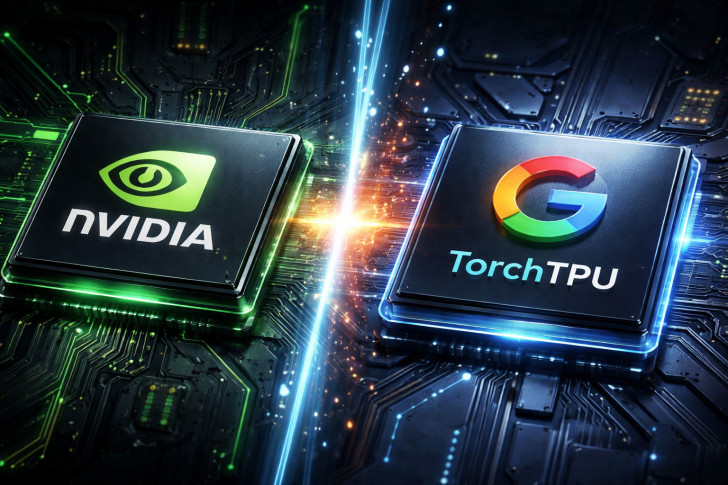
Google is building software that could let AI developers bypass Nvidia's ecosystem entirely. The move targets CUDA, the platform that's kept Nvidia ahead for years, and could reshape the $500 billion AI chip market.
Nvidia just rolled out its Nemotron-Cascade-8B reasoning model on Hugging Face, showing off impressive benchmark numbers powered by its Cascade RL training method.
Nvidia has received approval to sell reduced-performance AI chips to China, maintaining its presence in a crucial market despite tightened U.S. export controls.
Fresh projections show AI training demand will peak in 2025 before compute needs shift dramatically toward inference. The forecast includes growing adoption of custom chips, presenting long-term competitive challenges for NVDA.
NVIDIA's Orchestrator-8B scored 37.1% on the Humanity's Last Exam benchmark, beating GPT-5's 35.1% while running 2.5× more efficiently. Built on Qwen3-8B and trained with NVIDIA's ToolScale system, the model represents a shift toward cost-aware AI routing.
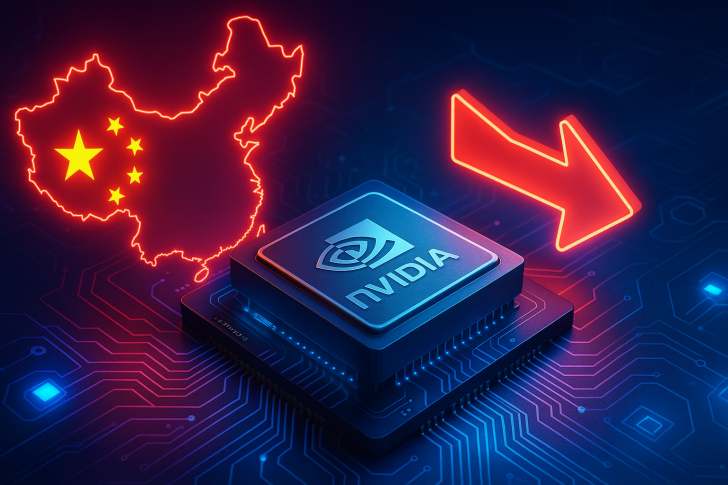
China is reducing its reliance on Nvidia hardware as regulators block major tech firms from deploying NVDA chips in new data centers. The shift is redirecting demand toward domestic accelerators from Huawei, Cambricon and in-house AI chip teams.
Nvidia now holds more than 80 % of the market for chips used in data centers and for artificial intelligence. In early 2021 its share was only 25 %. Intel besides AMD have not kept up with the steep rise in demand for hardware built for AI work, which let Nvidia expand quickly.
Nvidia's quarterly revenue has skyrocketed since late 2022, with fresh chart data revealing growth that closely tracks the company's massive 1,000% stock rally. The numbers highlight Nvidia's iron grip on AI-driven chip demand.
Nvidia's latest earnings were positioned as a critical test for the broader AI trade. The results delivered renewed clarity for sentiment across the sector.
Brookfield Asset Management has launched a $10 billion AI infrastructure fund backed by Nvidia and the Kuwait Investment Authority, with plans to scale it to $100 billion as global AI infrastructure demand accelerates.
Nvidia launched Nemotron Parse, an AI vision model that interprets complex document layouts with precision, transforming unstructured documents into structured data for enterprise use.
GMI Cloud is investing $500 million into a new Nvidia-powered AI data center in Taiwan, scheduled to go live by March 2026. The project includes 7,000 Blackwell GPUs and a contract value projected to reach $1 billion.
Traders are pulling back before Nvidia's Wednesday earnings and Thursday's delayed jobs report. Meanwhile, escalating AI infrastructure spending plans are fueling fresh questions about whether massive investments will actually pay off. A near-even split among hedge funds reflects the uncertainty surrounding NVDA's future.
Nvidia ($NVDA) has reportedly asked TSMC to ramp up 3nm wafer production for Blackwell chips by as much as 50%—from around 100k–110k wafers per month to roughly 160k. The company says demand is growing "month by month," and all three HBM suppliers are ready to support the push.
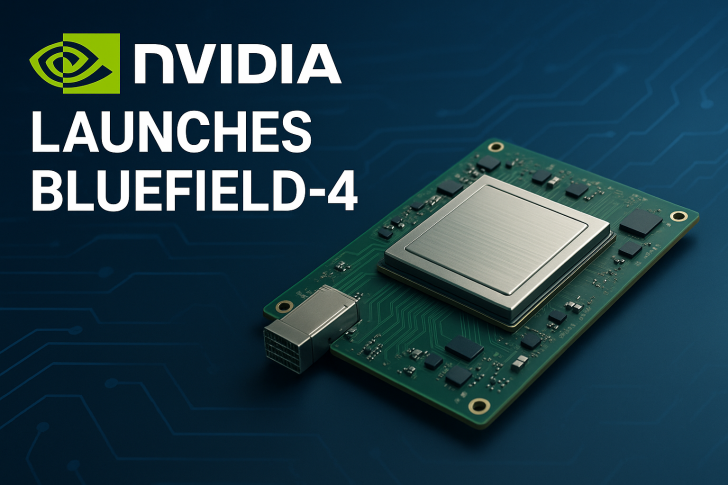
Nvidia introduces the BlueField-4 DPU, a 64-core processor that offloads networking, storage, and security tasks to boost AI data center performance by up to 6x.
Qualcomm just dropped two new AI accelerator chips (AI200 and AI250) aimed squarely at the data center market, challenging NVIDIA and AMD's dominance in AI hardware.
We use cookies to improve your experience on our site and to show you relevant advertising. To find our more, read our privacy policy and cookie policy


 Usman Salis

 Sergey Diakov
 Peter Smith

 Eseandre Mordi


 Marina Lyubimova

 Saad Ullah