64 articles
Why upstream data quality is becoming the backbone of scalable machine learning and LLM systems—and what production-grade pipelines actually look like.
Five key methods for fine-tuning large language models are gaining traction, dramatically cutting memory usage and computational costs while maintaining model performance.
LangChain just rolled out the LLM Inference Visualizer—a hands-on tool that lets you see exactly how context, prompts, and workflows shape what AI models spit out, all happening right before your eyes.
The AI landscape in 2025 saw major breakthroughs from DeepSeek R1, Claude 4, Grok 4, GPT-5 and Opus 4.1, with the industry rapidly moving toward "agent-first" platforms designed for real-world action.
A critical vulnerability in LangChain Core allows attackers to extract secrets and manipulate AI output through prompt injection, earning CVE-2025-68664 a severe 9.3 CVSS rating.
Epoch AI's 2025 retrospective reveals exponential acceleration in large language model development, with performance improvements now occurring in months rather than years across capability, efficiency, and research output metrics.
Ant Group released LLaDA2.0, a framework for scaling diffusion language models up to 100 billion parameters. The method converts existing auto-regressive models while boosting efficiency and performance.
New research framework ForestED transforms how AI systems detect data errors, replacing unstable LLM-based methods with explainable decision trees that cut costs and improve reliability.
Google's latest study pinpoints the exact point at which enlarging a team of AI agents quits paying off. The work shows that two factors govern the break even point - first, the rising overhead of getting the agents to synchronise and second, the way one agent's mistake is passed on to the rest. Once those two costs outweigh the benefit of an extra agent, further additions lower the system's overall performance.
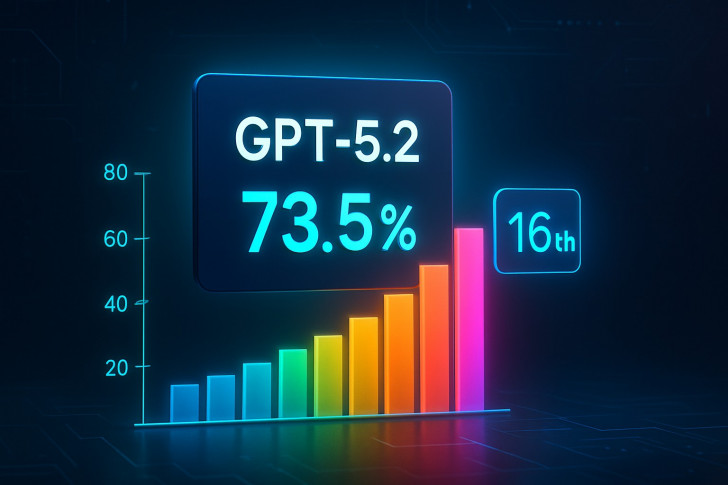
GPT-5.2 secured 16th position in the Dubesors LLM Benchmark with a 73.5% overall score, landing in the middle tier among over 250 evaluated large language models.
Zhipu AI has launched RealVideo, a real-time AI system that creates lifelike video responses with synced voice and lip movements. The technology is now available on Hugging Face for developers and researchers.
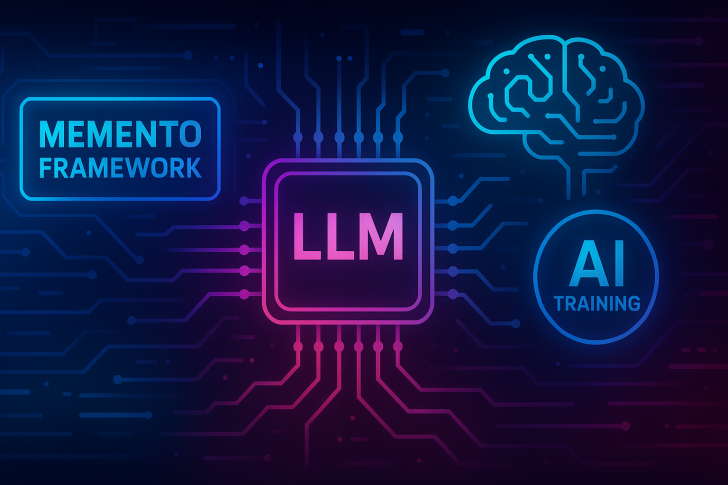
New open-source Memento framework enables LLMs to learn continuously through memory-based systems, achieving 87.88% Pass@3 on GAIA validation without modifying model weights.
Tencent AI Lab introduced R-Few, a self-evolving training framework that lets large language models improve themselves with minimal human input. The system uses a Challenger–Solver architecture to tackle key stability challenges in iterative LLM training.
Fresh Google Search Console data reveals a dramatic decline in click-through rates despite maintaining strong visibility. The numbers tell a clear story: AI-powered tools are fundamentally changing how people find and consume information online.
Microsoft will remove Copilot from WhatsApp in early 2026 because Meta has introduced new rules that limit AI chatbots. Users will still reach the assistant through its own apps and through web pages.
Memori introduces an open-source memory engine that gives AI agents long-term memory using standard SQL databases instead of expensive vector storage, cutting costs by up to 90 percent while working across all major LLM platforms.
New research reveals the exact moment when training costs become more efficient than inference scaling for large language models, with major implications for AI deployment strategy.
A comprehensive 94-page survey examines how scientific large language models are evolving through data-centric training and agent-driven workflows, analyzing 270 datasets and 190 benchmarks across multiple research disciplines.
A new Nature study reveals that GPT-5, despite sounding more confident and coherent than ever, still gets more than half of difficult medical cases wrong. The research highlights a troubling gap between how well AI can talk and how well it can actually think—raising serious safety concerns for healthcare applications.
A major cloud disruption has developers questioning their dependence on centralized AI infrastructure and exploring self-hosted alternatives.
We use cookies to improve your experience on our site and to show you relevant advertising. To find our more, read our privacy policy and cookie policy


 Marina Lyubimova

 Peter Smith
 Usman Salis

 Sergey Diakov



 Artem Voloskovets




 Saad Ullah
 Eseandre Mordi