114 articles
Perplexity's Deep Research feature now runs on Anthropic's Opus 4.6 model, achieving 81.9% benchmark performance and rolling out to Max and Pro subscribers.
Anthropic's latest AI agents can handle complex professional work like legal analysis and customer support, raising serious questions about the future of white-collar jobs.
Anthropic has opened up its Claude plugin system so that non-technical business teams can build custom AI workflows — no coding or engineering support needed.
Mercury's latest data reveals Anthropic has overtaken OpenAI as the top choice for AI spending among newly launched startups, claiming over 50% market share by Q4 2025 as early-stage companies rapidly embrace Claude's newer capabilities.
Anthropic's latest research reveals that AI coding tools don't automatically build skills—what matters is how developers use them. The study shows that curiosity and active learning make all the difference.
Anthropic has dramatically increased its revenue forecasts through 2029, projecting growth to $148 billion while acknowledging that model training costs will exceed $100 billion during the same period.
Claude Code installations in Visual Studio Code nearly doubled in January, signaling rapid adoption of AI coding assistants and highlighting growing momentum for Anthropic, with indirect exposure through Amazon and Google's stakes.
OpenAI and Anthropic just dropped their enterprise AI agent playbook, showing exactly how they build production-ready systems. The framework relies on multiple safety checks, content moderation, and tightly controlled function execution.
Anthropic is rolling out a Security Center for Claude Code that brings security scanning and issue tracking directly into the development workflow, marking a shift toward integrated safety tools in AI-powered coding platforms.
Nvidia's CEO praised Anthropic's Claude as a breakthrough in coding and reasoning capabilities, revealing widespread internal use at Nvidia and calling it essential for software companies.
Anthropic released new interpretability research outlining the "Assistant Axis," a method to measure and constrain AI behavior across 275 distinct archetypes. The work aims to reduce persona drift without harming model capability.
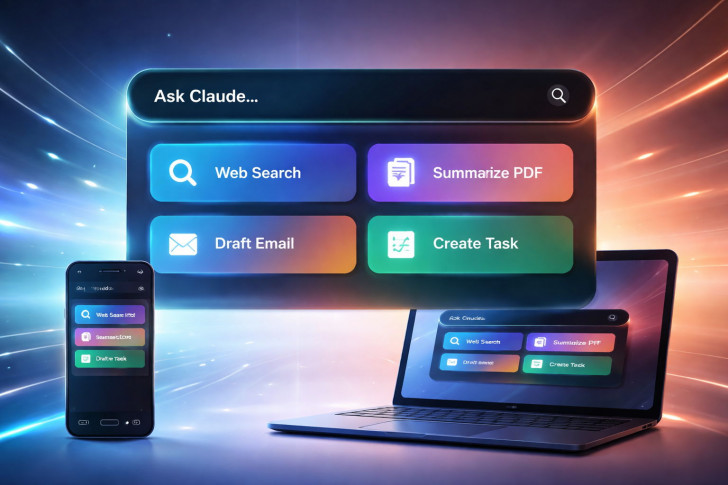
Anthropic's developing a new search menu for Claude that'll give users faster access to past chats and instant actions, making the AI assistant more practical for everyday workflows.
Anthropic has revealed a broad expansion of its research and engineering hiring, pointing to work across audio, biology, cybersecurity, scientific discovery, and computer vision. The new roles highlight the company's growing ambitions beyond text-based AI.
Anthropic now leads enterprise LLM API usage as corporate generative AI spending explodes 3.2× year-over-year, reaching $37 billion in 2025 amid widespread production deployments.
Anthropic's new Economic Index Report reveals how Claude AI performs across different education levels and regions, showing strong productivity boosts on difficult work but declining success rates as tasks get harder.
Claude's new feature lets you point it at a folder and watch it handle real tasks—from hunting down files to converting formats—without you lifting a finger.
Anthropic launches "Cowork," transforming Claude AI into a fully autonomous assistant that handles complex tasks independently—moving beyond simple chat to become your digital employee.
Anthropic rolled out Claude for Healthcare and expanded Claude for Life Sciences with HIPAA-compliant tools and specialized data connectors, strengthening the AI's presence in clinical, regulatory, and research environments.
Anthropic co-founder Daniela Amodei says AI tech keeps advancing, but real-world business impact lags as companies face adoption hurdles.
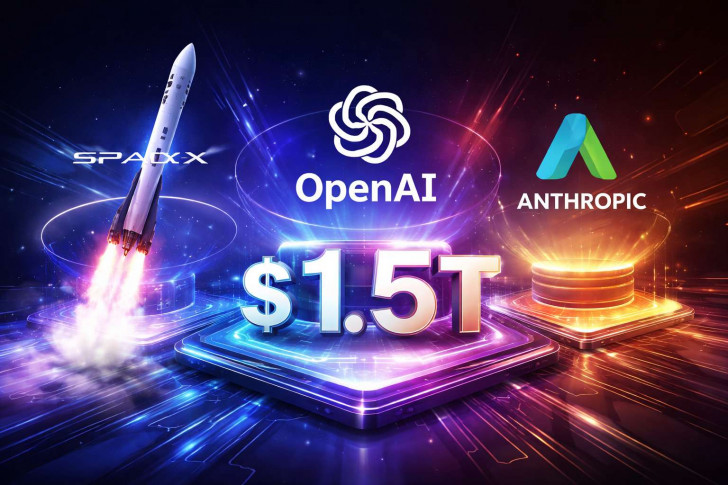
SpaceX, OpenAI and Anthropic are reportedly preparing potential IPOs as early as 2026, with combined valuations that could exceed $1.5 trillion and capital raises in the tens of billions of dollars. Even one listing could surpass the entire 2025 US IPO market.
We use cookies to improve your experience on our site and to show you relevant advertising. To find our more, read our privacy policy and cookie policy


 Peter Smith
 Victoria Bazir

 Artem Voloskovets


 Saad Ullah
 Alex Dudov


 Usman Salis

 Marina Lyubimova

 Eseandre Mordi


 Sergey Diakov