42 articles
Meta formally ends its metaverse drive and turns to artificial intelligence wearables after it acquires Limitless. $META stock rises three percent on the announcement.
Meta is in advanced discussions to buy billions of dollars' worth of Google TPUs, according to new reports. The potential deal could significantly boost Google Cloud revenue as the company begins selling TPUs for customer-owned data centers.
Meta launches SAM 3, a unified AI vision system that handles object detection, segmentation, and tracking. The model brings prompt-based features that will soon upgrade Instagram's editing capabilities.
Meta is building new high-growth revenue streams beyond advertising, including Business AI, consumer AI assistants, AI-generated content, wearables and Reality Labs. New data highlights rising engagement and expanding monetization potential across these emerging segments.
Meta will add "AI-driven impact" as a formal part of employee performance evaluations beginning in 2026, making the use of AI tools a core expectation across its workforce.
Meta's CFO revealed the company is making AI glasses a top priority in the 2026 Reality Labs budget after multiple stockouts showed stronger-than-expected demand. The division hasn't shared a specific outlook for operating losses yet.
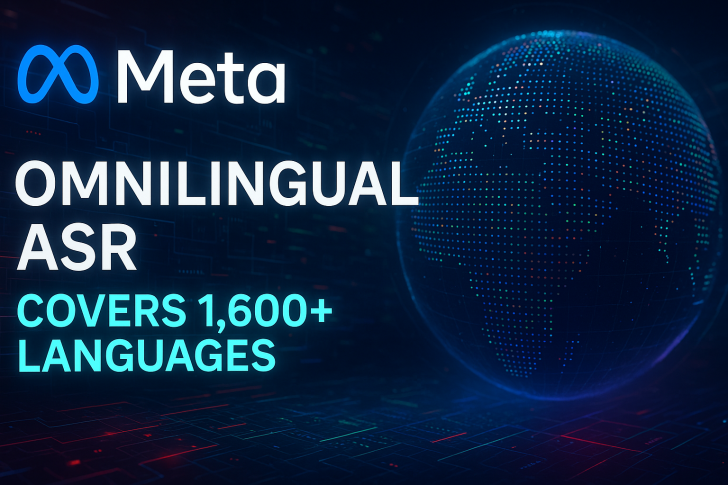
Meta announced Omnilingual Automatic Speech Recognition (ASR), expanding speech recognition to more than 1,600 languages—including 500 that never had ASR support before. It's being positioned as a major step toward universal transcription technology.
Meta launched its Generative Ads Recommendation Model (GEM), showing a 5% increase in Instagram ad conversions and marking a significant step forward in AI-powered ad personalization.
New projections show Google, Meta, and Amazon tightening their grip on U.S. advertising as AI drives engagement and ad precision to new heights.
A new analysis suggests global token generation is accelerating so fast that machine-created text could surpass all human speech by 2032—raising questions about how governments might regulate or tax an economy built on exponentially expanding AI data.
How tech giants like Meta are financing AI infrastructure through off-balance-sheet debt structures, raising questions about financial stability.
Meta introduced SPICE, a self-play system that lets AI models learn from real-world data without human supervision—delivering major improvements in reasoning accuracy and beating all previous self-improvement methods.
Ross Hendricks shared a chart showing nearly $900 billion in AI investments—including $400 billion from Meta, Microsoft, Amazon, and Google—massively outpacing actual revenue, sparking questions about when these bets will pay off.
A look at how Meta, Google, Amazon, and Microsoft are reshaping the tech landscape with unprecedented infrastructure investments — and what it might mean for everyone else.
Meta's stock crashed 11% — its worst day since 2022 — after CEO Mark Zuckerberg revealed plans to pump up to $72 billion into AI spending in 2025, triggering investor panic despite solid Q3 earnings.
Meta's Reality Labs division posted another $4.4 billion loss in Q3 2025, bringing total losses since 2020 to $73 billion as the company doubles down on its metaverse bet.
Meta AI's updated interface shows hidden features like Reasoning, Canvas, and Research — signaling a potential leap toward "Meta Superintelligence" tied to Llama 4.
Meta is cutting roughly 600 AI positions as part of a major reorganization that shifts focus from broad research to faster, product-focused teams centered around its Superintelligence Labs.
We use cookies to improve your experience on our site and to show you relevant advertising. To find our more, read our privacy policy and cookie policy


 Saad Ullah

 Artem Voloskovets

 Eseandre Mordi

 Peter Smith






 Usman Salis